I chose the beetroot for the first day of February for a reason. February is proclaimed a Heart Health month by American Heart Association. Read on and you will see why.
One can write an extensive thesis on medicinal propertied of this gem colored vegetable. It is recommended for prevention and treatment of anemia, hypertension, and other cardiovascular diseases.
Dark-colored varieties of beets help strengthen the capillary walls. Substances contained in its root have vasodilator, antispasmodic, anti-sclerotic and soothing effect. In addition, they facilitate the allocation of the excess fluid from the body and are needed for normal functioning of the heart. Beetroot shape itself resembles this vital organ!

Beet root crops contain 14-18% dry matter, 11-12% sugar, 1.7% protein, 5-17 mg of vitamin C. The beets also contain a small amount of carotene, vitamins B1, B2. But what gives this vegetable a special value is vitamin P, which can increase the elasticity of blood vessels, prevent multiple sclerosis and internal hemorrhage.
In addition, beet is useful for the liver. Contained in this vegetable betaine—which is also a natural dye—activates the liver cells and prevents their fatty degeneration. Beetroots contain significant amounts of pectin, which protect the body from exposure to radioactive and heavy metals (lead, strontium, etc.), contribute to the removal of cholesterol and inhibits growth of harmful microorganisms in the intestinal tract. Salts of iron, calcium, magnesium, and phosphorus, cobalt found in beets also activate the blood formation and regulate metabolism. In iron content, beets trail only to garlic.
Among all other things, beetroot is rich in organic acids that are useful for human body: malic, citric, and tartaric. It also contains minerals such as phosphorus, calcium, sulfur, and sodium.
And let us not leave out the leaves. Beet leaves contain about the same nutrients as the root, but the beet tops have more vitamin C, although less fiber.

Today, I prepared a simple lunch recipes: beetroot soup-puree—although the most traditional soup in this category would be Borsch, but its recipe I will share separately!—and pies with beet leaves and cheese.
This soup is borrowed from Turkish cuisine, where it is traditionally made from roasted beetroots.

◊◊◊
ROASTED BEET SOUP
6 medium beetroots
2 TB spoons vegetable oil
1 TB spoon unsalted butter
1 cup diced white onions
1 cup chopped carrots
1 cup chopped celery
2 t spoons ground cumin
1/2 t spoon ground red hot pepper
1 t spoon ground black pepper
1 t spoon sea salt
1-2 dry bay leaves
6 cups water or broth
bunch of fresh dill weed
sour cream (or Greek style yogurt)
- Heat the oven to 375°F, wrap each washed and patted dry beetroot in aluminum foil and bake for 1 hour. Remove from the oven—beets have to be tender but not overcooked—cool, peel and chop into disks.
- In the pot, heat oil and melt butter in it. Add the chopped vegetables: onions, carrots, celery, garlic, and sauté them for 5-7 min or until onions are translucent.
- Add spices (besides salt) and beets; mix and pour water or broth and bring to boil. Once boiled, add salt, turn the heat to medium-low and cook for 30 minutes.
- Remove from heat, take out the bay leaves, and blend with an immersion blender. Return to heat for 10 more minutes.
- Serve with dollop of sour cream (or yogurt) and chopped fresh dill weed.
~~◊◊◊~~
Beet leaves and cheese pies—tsakharadhiin—are traditional Osetian dish. Osetins are one of the indigenous people of North Caucasus region, and I'm 1/8th Osetian (I know it's totally irrelevant).
You may use already prepared yeast dough or buy frozen bread dough and thaw only one loaf, but I deiced to make my own using whole wheat flour; and instead of butter I used clarified butter—it gives sweet note to the pies that compliments saltiness of the cheese and tartness of greens.
Traditionally, Osetian cheese that is similar to Greek feta is used. However, Greek feta works just fine! This recipe yields 3 10 inch pies: it is Osetian tradition to bake three round pies at a time. And to serve it with sour cream and dill dip. Only I used Greek style yogurt in lieu of sour cream. I used the same dip with the beet soup, too.
◊◊◊
TSAKHARADJIN—OSETIAN BEET LEAVES AND CHEESE PIE
 For the dough:
1 TB spoon dry active yeast
2 cup warm (100-110F) water, divided
1 t spoon sugar
1 TB spoon vegetable oil
1 t spoon salt
2 cups whole wheat flour
1 1/2 cup barley flour, divided (or all purpose flour)
+more for dusting the surface
For the filling:
2 cups beet leaves
1½ (20 lb) pounds feta cheese
One bunch of scallions
1 cup chopped fresh dill weed
For serving:
½ cup clarified butter (or melted butter)
Sour cream (or Greek style yogurt) with chopped dill weed
To make the dough:
- To 1 cup of warm water, add yeast and sugar and without mixing let stand for 10 minutes.
- In a bowl with 2 cups of whole-wheat flour and 1 cup of barley (or all purpose) flour, pour the water, oil, and salt; mix the sponge with a wooden spoon.
- On dry clean surface pour 1/2 cup of barley (or all purpose) flour, take the sponge and knead the dough until most the flour is used up; dust the dough with flour and put it back into the bowl, cover with clean kitchen towel and let stand in a warm and non drifty place for and hour. Meanwhile, prepare the filling.

To make the filling:
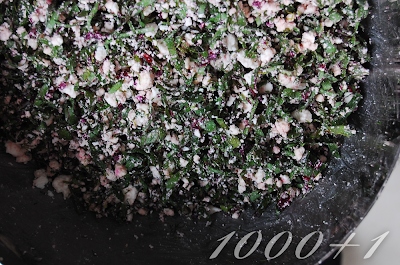
- Wash and dry the beet leaves and shop them into thin ribbons; mix it with finely chopped scallions and dill.
- In a separate bowl crumble the cheese, then add the greens and black pepper.
- Divide the filling into 3 parts and roll into ball shape.
To assemble and bake the pies:
- Preheat the oven to 450°F and keep cast iron skillet (of metal baking sheet) inside the oven to be heated, too.
- Divide the dough into tree parts. On a dusted with flour surface roll the dough with a rolling pin or stretch with hands into circles about 7/8 of an inch thick.
- Put the filling in the center of the dough, push it in, and gather the dough from around the edges closing in it on top. Pinch off any excess dough. With hands even out the pie. Push it into shape (10 inches in diameter) and poke a hole 1 inch in size in the middle.
- Transfer the pie on a hot skillet (baking sheet) and bake for 15-20 until it starts to turn light brown.
- Brush the pie with butter. Repeat for the second and third pie.
- Serve hot, cut in 6 pieces, with a sour cream (yogurt) and dill dip.


I understand that this time of year many people would prefer chocolate as their main ingredient not only because it makes a nice valentine day treat but also because its dark varieties are good for the health. I understand also that beet might not win competing for a place on your table this month because it might not look so attractive. But have you seen or tasted Cocoa au naturelle? Right, now beet doesn't look so bad!
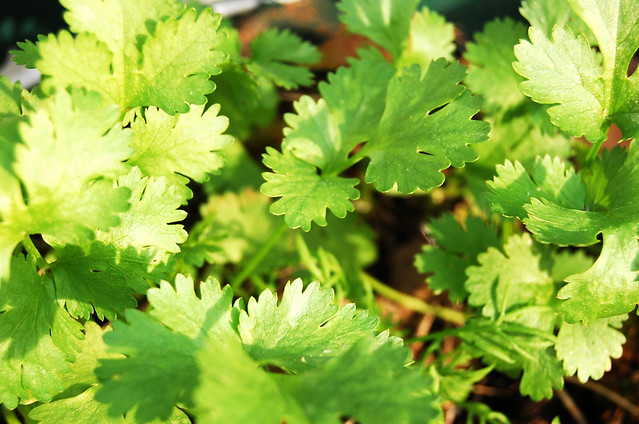
 Cilantro leaves are so delicate and wilt fast, to keep them clean and crisp keep them in a bowl of ice cold water before cooking with it.